
Mines and Mine: Meaning, Differences, and Correct English Grammar Usage
Many English learners get confused between mines and mine because both words look almost the same. However, their meanings and grammar rules are completely different. Using the wrong word can make your sentence sound incorrect or unprofessional.
For example:
❌ This phone is mines.
✅ This phone is mine.
The confusion usually happens because people think “mine” should follow the same pattern as words like “yours” or “theirs.” But English grammar works differently here.
In this guide, you will learn:
- the meaning of mine and mines
- the difference between them
- grammar rules
- common mistakes
- sentence examples
- pronunciation
- real-life usage tips
By the end, you will confidently understand how to use mines and mine correctly in spoken and written English.
Quick Answer
Here is the simple answer:
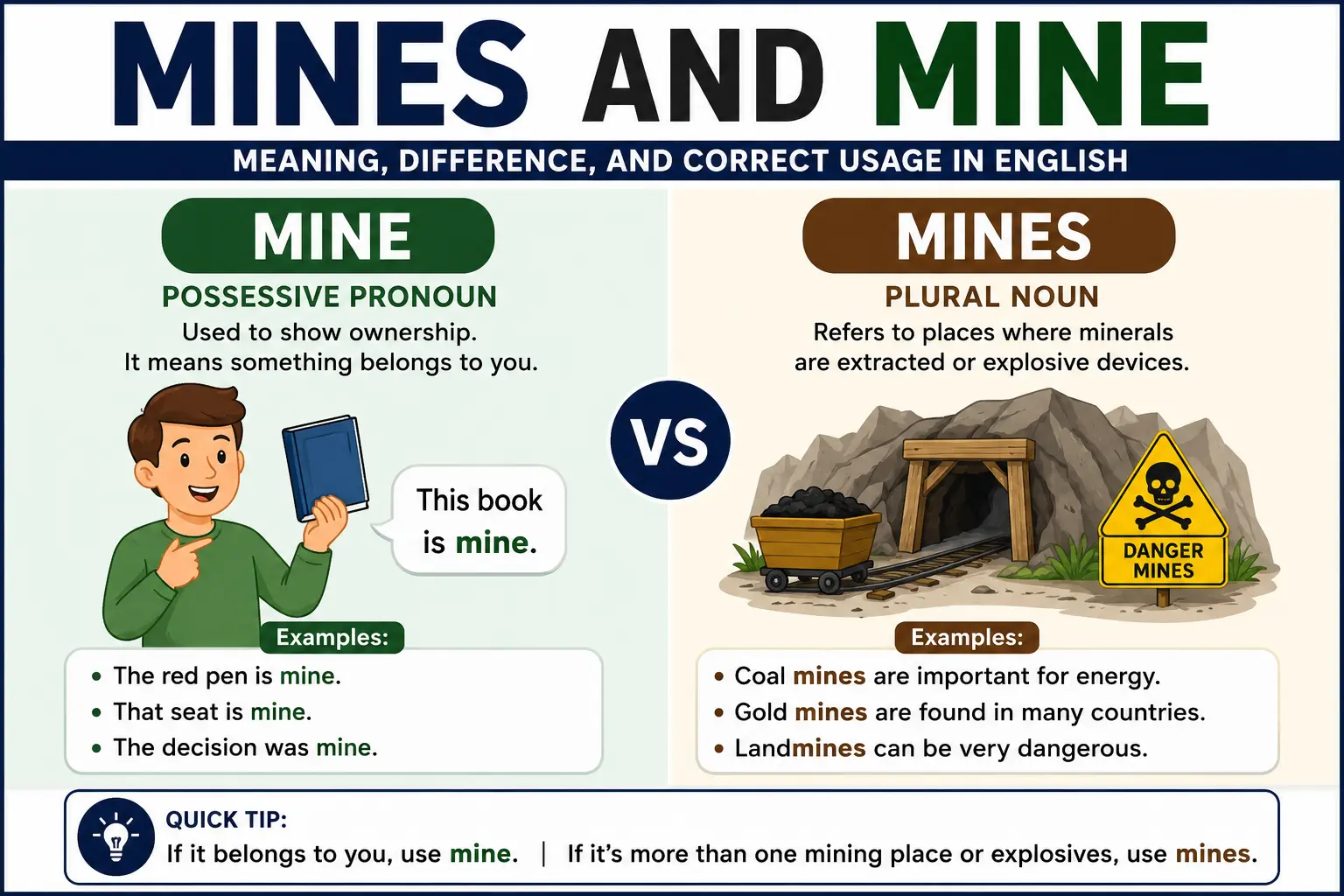
- Mine = shows ownership or possession
- Mines = plural form of the noun “mine”
Examples:
✅ This bag is mine.
✅ Gold mines are common in some countries.
A simple memory trick:
- If something belongs to you → use mine
- If you are talking about mining places or explosives → use mines
What Does “Mine” Mean?
The word mine is a possessive pronoun. It shows that something belongs to someone.
You use it instead of repeating a noun.
Examples:
- This laptop is mine.
- The decision was mine.
- That seat is mine.
- The blue jacket is mine.
Notice the pattern:
Instead of saying:
- This is my laptop.
You can say:
- This laptop is mine.
Both sentences are correct. The structure is simply different.
What Does “Mines” Mean?
The word mines is the plural form of the noun “mine.”
It usually refers to:
- places where minerals are taken from the earth
- underground excavation sites
- explosive devices used in war
Examples:
- Coal mines produce energy.
- Gold mines exist in many countries.
- Soldiers removed landmines from the area.
Unlike “mine,” this word does not show ownership.
Difference Between Mines and Mine
Understanding the difference between mines and mine becomes easy when you look at grammar and meaning together.
| Word | Part of Speech | Meaning | Example |
|---|---|---|---|
| Mine | Possessive Pronoun | Belongs to me | This book is mine |
| Mines | Plural Noun | Mining locations or explosives | These mines are dangerous |
The words may look similar, but they belong to different grammar categories.
Why People Confuse Mines and Mine
Many learners make this mistake because English has similar possessive words like:
- yours
- hers
- theirs
So people assume:
- mine → mines
But that rule does not apply here.
The word “mine” is already complete. It does not need an extra “s.”
That is why these sentences are wrong:
❌ This car is mines.
❌ The phone belongs to mines.
Correct versions:
✅ This car is mine.
✅ The phone belongs to me.
This confusion is extremely common in spoken English and online chatting.
Grammar Rule Behind “Mine”
The grammar rule is actually simple.
“Mine” is a possessive pronoun. Possessive pronouns replace nouns and show ownership.
Examples of possessive pronouns:
- mine
- yours
- his
- hers
- ours
- theirs
Example:
- This is my pen.
- This pen is mine.
The word “mine” replaces “my pen.”
That is why adding “s” is incorrect in standard English grammar.
My vs Mine Explained
Many learners also confuse “my” and “mine.”
Here is the difference:
| Word | Usage |
|---|---|
| My | Used before a noun |
| Mine | Replaces the noun |
Examples:
- My phone is expensive.
- The expensive phone is mine.
- My bag is black.
- The black bag is mine.
A simple rule:
- Use my before a noun
- Use mine after the noun
Can “Mines” Ever Show Possession?
No. In standard English grammar, “mines” never shows possession.
Incorrect:
❌ This house is mines.
Correct:
✅ This house is mine.
However, some people may use “mines” in casual speech or dialects. Still, it is considered grammatically incorrect in formal English.
You should avoid using it in:
- exams
- academic writing
- professional emails
- blog articles
- interviews
Sentence Structure Examples
Learning sentence patterns helps you avoid grammar mistakes.
Ownership Structure
Pattern:
- noun + is + mine
Examples:
- The wallet is mine.
- That room is mine.
- The responsibility is mine.
Mining Structure
Pattern:
- adjective + mines
Examples:
- Coal mines are dangerous.
- Diamond mines create jobs.
- Old mines were closed years ago.
These sentence patterns make the difference between mines and mine much easier to remember.
Common Mistakes With Mines and Mine
Here are the mistakes people make most often.
Mistake 1
❌ This pen is mines.
✅ This pen is mine.
Mistake 2
❌ Mine car is outside.
✅ My car is outside.
Mistake 3
❌ Coal mine are dangerous.
✅ Coal mines are dangerous.
Mistake 4
❌ The phone belongs to mines.
✅ The phone belongs to me.
Small grammar mistakes can completely change sentence meaning. Always check whether you are talking about ownership or physical places.
Spoken vs Written English
Sometimes you may hear people say “mines” in casual conversation.
For example:
- “That bag is mines.”
This can happen in:
- informal speech
- texting
- regional dialects
However, proper English grammar still considers it incorrect.
In formal English:
- use “mine” for ownership
- use “mines” only for plural nouns
If you want professional and natural writing, follow the standard grammar rule.
Real-Life Examples of Mine and Mines
Here are some everyday examples.
Examples Using “Mine”
- The red notebook is mine.
- That idea was mine.
- This seat is mine.
- The final decision is mine.
Examples Using “Mines”
- Gold mines attract many workers.
- The country closed several coal mines.
- Landmines remain dangerous after wars.
- These mines produce copper and iron.
Reading examples regularly helps improve grammar naturally.
Pronunciation Guide
Correct pronunciation also matters.
| Word | Pronunciation |
|---|---|
| Mine | /maɪn/ |
| Mines | /maɪnz/ |
The second word has a strong “z” sound at the end because it is plural.
Practicing pronunciation can improve both speaking and listening skills.
Mine as Different Parts of Speech
Interestingly, the word “mine” can work in different ways in English.
1. Possessive Pronoun
Example:
- The jacket is mine.
2. Noun
Example:
- The workers entered the mine.
3. Verb
Example:
- Companies mine gold in this region.
This makes English more flexible but also more confusing for learners.
Why Context Matters
Context is the key to understanding mines and mine correctly.
Look at these examples:
- This phone is mine.
(ownership) - The workers entered the mines.
(physical places)
Even though the words look similar, context completely changes their meaning.
That is why understanding sentence purpose is important.
Ask yourself:
- Am I talking about ownership?
- Or am I talking about locations or objects?
The answer tells you which word to use.
Quick Grammar Quiz
Choose the correct answer.
1. This backpack is ___.
- mine
- mines
✅ Correct Answer: mine
2. Coal ___ are found in many countries.
- mine
- mines
✅ Correct Answer: mines
3. The blue car is ___.
- mine
- mines
✅ Correct Answer: mine
4. Diamond ___ create many jobs.
- mine
- mines
✅ Correct Answer: mines
Simple exercises like these improve grammar faster.
Frequently Asked Questions
Is “This is mines” correct?
No. The correct sentence is:
- This is mine.
What does “mine” mean in grammar?
It is a possessive pronoun that shows ownership.
What does “mines” mean?
It refers to multiple mining locations or explosive devices.
Can “mine” be a noun?
Yes. Example:
- The workers entered the mine.
What is the difference between my and mine?
“My” comes before a noun, while “mine” replaces the noun.
Example:
- My phone
- The phone is mine
Are landmines and mines the same?
Landmines are explosive devices. Mines can also refer to excavation sites depending on context.
Final Conclusion
Understanding the difference between mines and mine is much easier once you learn the grammar rule behind each word.
Use mine when talking about ownership:
- This book is mine.
Use mines when talking about multiple mining locations or explosive devices:
- Coal mines produce energy.
The biggest mistake learners make is treating “mine” like other possessive words such as “yours” or “theirs.” However, “mine” is already complete and never needs an extra “s.”
A simple trick to remember:
- ownership = mine
- physical places or explosives = mines
Once you understand this rule, you will use both words correctly and naturally in everyday English.